2. The Projected Framework
The projected framework was supported by the Contingency Theory and the Resource-Based View theory (RBV). These theories provided a foundation for exploring both external and internal environmental determinants of export performance
| [24] | Harcharanjit, B., Harvie, C., & Lee, J. Y. (2014). The conceptual framework of export performance for SMEs: A literature review. International Journal of Management Practice, 7(4), 307–328. https://doi.org/10.1108/JBIM-07-2015-0126 |
| [27] | Imed, B. K., & Afef, B. H. (2011). Theoretical models of export performance: A critical review. International Business Research, 4(2), 173–182.
https://doi.org/10.5539/ibr.v4n2p173 |
| [38] | Majocchi, A., Bacchiocchi, E., & Mayrhofer, U. (2005). Export performance and the internationalization process: An empirical investigation into SMEs. European Journal of Marketing, 39(7/8), 838–861.
https://doi.org/10.1108/03090560510601770 |
[24, 27, 38]
and their relative effect on export performance. They attempted to identify the factors that explain why firms achieve varying levels of export performance
| [3] | Brouthers, L. E., Nakos, G., Hadjimarcou, J., & Brouthers, K. D. (2013). Key factors for successful export performance for small firms. Journal of International Marketing, 21(3), 85–104. https://doi.org/10.1509/jim.13.0035 |
| [9] | Chen, H., Wang, W., & Li, Y. (2016). The mediating effect of supply chain agility on the relationship between dynamic capabilities and export performance. Journal of Manufacturing Technology Management, 27(5), 701–724.
https://doi.org/10.1108/JMTM-01-2016-0002 |
[3, 9]
.
The theories further claimed that a firm’s export performance is shaped by both internal factors (such as managerial characteristics, firm characteristics, and export marketing strategy determinants) and external factors (such as the extent of competition, foreign market characteristics, and technological intensity)
| [24] | Harcharanjit, B., Harvie, C., & Lee, J. Y. (2014). The conceptual framework of export performance for SMEs: A literature review. International Journal of Management Practice, 7(4), 307–328. https://doi.org/10.1108/JBIM-07-2015-0126 |
[24]
. Cavusgil et al., 1994) also state that a firm’s export performance is directly determined by firm characteristics and is moderated by marketing strategy.
Hence, the commonly applied conceptual framework for the determinants of firm export performance, based on the RBV and Contingency View, classified the factors into internal and external categories
| [3] | Brouthers, L. E., Nakos, G., Hadjimarcou, J., & Brouthers, K. D. (2013). Key factors for successful export performance for small firms. Journal of International Marketing, 21(3), 85–104. https://doi.org/10.1509/jim.13.0035 |
| [9] | Chen, H., Wang, W., & Li, Y. (2016). The mediating effect of supply chain agility on the relationship between dynamic capabilities and export performance. Journal of Manufacturing Technology Management, 27(5), 701–724.
https://doi.org/10.1108/JMTM-01-2016-0002 |
[3, 9]
. Therefore, export performance tended to be conditioned by both environmental and firm-specific characteristics
| [3] | Brouthers, L. E., Nakos, G., Hadjimarcou, J., & Brouthers, K. D. (2013). Key factors for successful export performance for small firms. Journal of International Marketing, 21(3), 85–104. https://doi.org/10.1509/jim.13.0035 |
| [9] | Chen, H., Wang, W., & Li, Y. (2016). The mediating effect of supply chain agility on the relationship between dynamic capabilities and export performance. Journal of Manufacturing Technology Management, 27(5), 701–724.
https://doi.org/10.1108/JMTM-01-2016-0002 |
| [24] | Harcharanjit, B., Harvie, C., & Lee, J. Y. (2014). The conceptual framework of export performance for SMEs: A literature review. International Journal of Management Practice, 7(4), 307–328. https://doi.org/10.1108/JBIM-07-2015-0126 |
[3, 9, 24]
.
In the research conceptual framework, export marketing strategy functions as a significant intermediate variable
| [9] | Chen, H., Wang, W., & Li, Y. (2016). The mediating effect of supply chain agility on the relationship between dynamic capabilities and export performance. Journal of Manufacturing Technology Management, 27(5), 701–724.
https://doi.org/10.1108/JMTM-01-2016-0002 |
[9]
. It is formulated based on a firm’s internal resources and the external forces it faces, ultimately influencing competitive advantage and determining export performance
| [9] | Chen, H., Wang, W., & Li, Y. (2016). The mediating effect of supply chain agility on the relationship between dynamic capabilities and export performance. Journal of Manufacturing Technology Management, 27(5), 701–724.
https://doi.org/10.1108/JMTM-01-2016-0002 |
[9]
. Empirical findings, therefore, supported the central and direct influence of export marketing strategy on export performance
| [9] | Chen, H., Wang, W., & Li, Y. (2016). The mediating effect of supply chain agility on the relationship between dynamic capabilities and export performance. Journal of Manufacturing Technology Management, 27(5), 701–724.
https://doi.org/10.1108/JMTM-01-2016-0002 |
[9]
.
Prior studies have found that research tends to focus on the direct influence of determinant factors on export performance while neglecting their intermediate influence
| [9] | Chen, H., Wang, W., & Li, Y. (2016). The mediating effect of supply chain agility on the relationship between dynamic capabilities and export performance. Journal of Manufacturing Technology Management, 27(5), 701–724.
https://doi.org/10.1108/JMTM-01-2016-0002 |
[9]
. Building upon this, this study took advanced steps to advocate for considering more intermediate influences
| [9] | Chen, H., Wang, W., & Li, Y. (2016). The mediating effect of supply chain agility on the relationship between dynamic capabilities and export performance. Journal of Manufacturing Technology Management, 27(5), 701–724.
https://doi.org/10.1108/JMTM-01-2016-0002 |
[9]
. In doing so, it refined the core theoretical conceptual framework and offered comprehensive perspectives
| [9] | Chen, H., Wang, W., & Li, Y. (2016). The mediating effect of supply chain agility on the relationship between dynamic capabilities and export performance. Journal of Manufacturing Technology Management, 27(5), 701–724.
https://doi.org/10.1108/JMTM-01-2016-0002 |
[9]
.
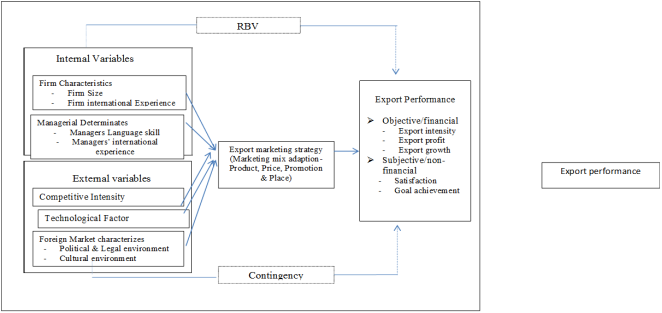
In the conceptual framework model presented below in
Figure 1, all relationships between concepts, dimensions, components, and indices were defined as measurement relationships in regression models. Here, all hypotheses of the conceptual models were defined in correlation form due to their measurement nature. The conceptual framework was also based on the constructive and interrelated nature of export marketing strategies alongside internal and external environmental forces
| [43] | Oyeniyi, O. J. (2009). Determinants of export performance of manufacturing firms in Nigeria: A conceptual framework. International Journal of Marketing Studies, 1(2), 136–144.
https://doi.org/10.5539/ijms.v1n2p136 |
[43]
.
Export performance, a key element of the model, is the degree to which a firm’s objectives—both objective/financial and subjective/non-financial—with respect to exporting a product into international markets are achieved through the planning and execution of the export marketing strategy
| [9] | Chen, H., Wang, W., & Li, Y. (2016). The mediating effect of supply chain agility on the relationship between dynamic capabilities and export performance. Journal of Manufacturing Technology Management, 27(5), 701–724.
https://doi.org/10.1108/JMTM-01-2016-0002 |
| [43] | Oyeniyi, O. J. (2009). Determinants of export performance of manufacturing firms in Nigeria: A conceptual framework. International Journal of Marketing Studies, 1(2), 136–144.
https://doi.org/10.5539/ijms.v1n2p136 |
[9, 43]
. Export market objectives can be economic (e.g., profit, growth, or intensity) and/or subjective (e.g., satisfaction and goal achievement)
| [6] | Cavusgil, S. T., & Zou, S. (1994). Marketing strategy-performance relationship: An investigation of the empirical link in export market ventures. Journal of Marketing, 58(1), 1–21. https://doi.org/10.2307/1252247 |
| [9] | Chen, H., Wang, W., & Li, Y. (2016). The mediating effect of supply chain agility on the relationship between dynamic capabilities and export performance. Journal of Manufacturing Technology Management, 27(5), 701–724.
https://doi.org/10.1108/JMTM-01-2016-0002 |
| [43] | Oyeniyi, O. J. (2009). Determinants of export performance of manufacturing firms in Nigeria: A conceptual framework. International Journal of Marketing Studies, 1(2), 136–144.
https://doi.org/10.5539/ijms.v1n2p136 |
[6, 9, 43]
. The research framework proposed for the study is presented below.
Figure 1. The conceptual framework of the research, Researchers view 2020.
Furthermore, the level of influence exerted by the export marketing strategy was reflected in the firm's export performance success
| [9] | Chen, H., Wang, W., & Li, Y. (2016). The mediating effect of supply chain agility on the relationship between dynamic capabilities and export performance. Journal of Manufacturing Technology Management, 27(5), 701–724.
https://doi.org/10.1108/JMTM-01-2016-0002 |
| [43] | Oyeniyi, O. J. (2009). Determinants of export performance of manufacturing firms in Nigeria: A conceptual framework. International Journal of Marketing Studies, 1(2), 136–144.
https://doi.org/10.5539/ijms.v1n2p136 |
[9, 43]
. The internal/controllable determinants in the conceptual framework—managerial characteristics and firm characteristics—influenced the use of export marketing strategy and the capability to select and implement a specific marketing strategy
| [9] | Chen, H., Wang, W., & Li, Y. (2016). The mediating effect of supply chain agility on the relationship between dynamic capabilities and export performance. Journal of Manufacturing Technology Management, 27(5), 701–724.
https://doi.org/10.1108/JMTM-01-2016-0002 |
| [43] | Oyeniyi, O. J. (2009). Determinants of export performance of manufacturing firms in Nigeria: A conceptual framework. International Journal of Marketing Studies, 1(2), 136–144.
https://doi.org/10.5539/ijms.v1n2p136 |
[9, 43]
. Crucially, the strategy aligned with the exporter’s strengths, leverage market opportunities, offset weaknesses, and overcame threats
| [6] | Cavusgil, S. T., & Zou, S. (1994). Marketing strategy-performance relationship: An investigation of the empirical link in export market ventures. Journal of Marketing, 58(1), 1–21. https://doi.org/10.2307/1252247 |
| [9] | Chen, H., Wang, W., & Li, Y. (2016). The mediating effect of supply chain agility on the relationship between dynamic capabilities and export performance. Journal of Manufacturing Technology Management, 27(5), 701–724.
https://doi.org/10.1108/JMTM-01-2016-0002 |
| [43] | Oyeniyi, O. J. (2009). Determinants of export performance of manufacturing firms in Nigeria: A conceptual framework. International Journal of Marketing Studies, 1(2), 136–144.
https://doi.org/10.5539/ijms.v1n2p136 |
[6, 9, 43].
Conversely, the external/uncontrollable determinants in the conceptual framework included the intensity of foreign competition across markets, foreign market characteristics (such as the country’s political environment and sociocultural forces), and technological forces. These factors influenced the export marketing strategy, which in turn influenced export performance
| [9] | Chen, H., Wang, W., & Li, Y. (2016). The mediating effect of supply chain agility on the relationship between dynamic capabilities and export performance. Journal of Manufacturing Technology Management, 27(5), 701–724.
https://doi.org/10.1108/JMTM-01-2016-0002 |
| [43] | Oyeniyi, O. J. (2009). Determinants of export performance of manufacturing firms in Nigeria: A conceptual framework. International Journal of Marketing Studies, 1(2), 136–144.
https://doi.org/10.5539/ijms.v1n2p136 |
[9, 43]
. Thus, a firm can respond to the interaction of external and internal forces in various ways to attain its objectives
| [9] | Chen, H., Wang, W., & Li, Y. (2016). The mediating effect of supply chain agility on the relationship between dynamic capabilities and export performance. Journal of Manufacturing Technology Management, 27(5), 701–724.
https://doi.org/10.1108/JMTM-01-2016-0002 |
| [43] | Oyeniyi, O. J. (2009). Determinants of export performance of manufacturing firms in Nigeria: A conceptual framework. International Journal of Marketing Studies, 1(2), 136–144.
https://doi.org/10.5539/ijms.v1n2p136 |
[9, 43]
.
Consequently, the firm’s reaction may take the form of a marketing plan that considers all aspects of product, pricing, distribution, and promotion
| [9] | Chen, H., Wang, W., & Li, Y. (2016). The mediating effect of supply chain agility on the relationship between dynamic capabilities and export performance. Journal of Manufacturing Technology Management, 27(5), 701–724.
https://doi.org/10.1108/JMTM-01-2016-0002 |
| [43] | Oyeniyi, O. J. (2009). Determinants of export performance of manufacturing firms in Nigeria: A conceptual framework. International Journal of Marketing Studies, 1(2), 136–144.
https://doi.org/10.5539/ijms.v1n2p136 |
[9, 43]
. Additionally, the current situation of the export market, including prospective demand, cultural differences, brand and product awareness, and dissimilarity of legal systems, can influence the selection of a marketing strategy
| [6] | Cavusgil, S. T., & Zou, S. (1994). Marketing strategy-performance relationship: An investigation of the empirical link in export market ventures. Journal of Marketing, 58(1), 1–21. https://doi.org/10.2307/1252247 |
| [43] | Oyeniyi, O. J. (2009). Determinants of export performance of manufacturing firms in Nigeria: A conceptual framework. International Journal of Marketing Studies, 1(2), 136–144.
https://doi.org/10.5539/ijms.v1n2p136 |
[6, 43]
.
4. Formulation of Propositions
H1: The adoption of the export marketing mix strategy (product, price, promotion, and channel selection) contributed positively to export performance.
H2: Intensive competition contributed positively to export performance.
H2a: Intensive competition contributed positively to the adoption of the export marketing strategy.
H3: Political and legal environments had a positive influence on export performance.
H3a: Political and legal environments contributed positively to the adoption of the export marketing mix strategy.
H4: Cultural environments contributed positively to export performance.
H4a: Cultural environments contributed positively to the adoption of the export marketing strategy.
H5: The appropriate use of technology contributed positively to export performance.
H5a: The appropriate use of technology contributed positively to the adoption of the export marketing strategy.
H6: Firm size contributed significantly to export performance.
H6a: Firm size contributed positively to the adoption of the export marketing mix strategy.
H7a: Firm export experience contributed positively to export performance.
H7a: Firm export experience contributed positively to the adoption of the export marketing strategy.
H8: Manager’s international experience contributed positively to export performance.
H8a: Manager’s international experience had a positive association with the adoption of the export marketing strategy.
H9: Manager’s foreign language skill contributes positively to export performance.
H9a: Manager’s foreign language skill had a positive association with the adoption of the export marketing mix strategy.
H10: Export Marketing Strategy mediated the association between internal determinants and export performance.
H11: Export Marketing Strategy mediated the association between external determinants and export performance.
H12: All external factors influenced export performance equally.
H12a: Some external factors influenced export performance more than others.
H13: All internal factors influenced export performance equally.
H13a: Some internal factors influenced export performance more than others.
H14: All export marketing mix strategies influenced export performance equally.
H14a: Some export marketing mix strategies influence export performance more than others.
5. Research Methodology
The study employed a mixed research approach, using both quantitative and qualitative methods for data triangulation. Empirical findings demonstrated the level of significance of the relationships, while qualitative information explored the interpretation of the phenomena
| [18] | Gloria, A. M. (2016). Advanced research methodology in business and economics. Routledge. |
| [59] | Zikmund, W. G., Babin, B. J., Carr, J. C., & Griffin, M. (2013). Business research methods (9th ed.). South-Western Cengage Learning. |
[18, 59]
. Quantitative research excels at summarising large data sets to enable generalisation of findings
| [45] | Saunders, M. N. K., Lewis, P., & Thornhill, A. (2019). Research methods for business students (8th ed.). Pearson Education. |
[45]
.
Conversely, the qualitative data were used to provide causal support for the quantitative findings through rich interpretation
| [25] | He, X., Zhang, M., & Yang, B. (2013). A mixed-methods approach to investigating the factors influencing export performance in China. Journal of World Business, 48(3), 369–380. https://doi.org/10.1016/j.jwb.2012.07.001 |
[25]
. The mixed research method was used not only to develop, extend, and test theories but also to achieve triangulation between methods by enhancing quantitative results with rich interview data
| [11] | Creswell, J. W., and Clark, V. L. P. (2018). Designing and conducting mixed methods research (3rd ed.). Sage Publications. |
| [45] | Saunders, M. N. K., Lewis, P., & Thornhill, A. (2019). Research methods for business students (8th ed.). Pearson Education. |
[11, 45]
Accordingly, a basic quantitative outcome was reinforced through in-depth investigation
| [3] | Brouthers, L. E., Nakos, G., Hadjimarcou, J., & Brouthers, K. D. (2013). Key factors for successful export performance for small firms. Journal of International Marketing, 21(3), 85–104. https://doi.org/10.1509/jim.13.0035 |
[3]
Combining these two approaches overcame some inherent limitations when each methodology was used alone
| [45] | Saunders, M. N. K., Lewis, P., & Thornhill, A. (2019). Research methods for business students (8th ed.). Pearson Education. |
[45]
.
Moreover, among the quantitative methods, the present study employed questionnaires to collect data. Thus, sequential mixed method procedures were involved, beginning with a quantitative method where a theory or concept was tested, followed by a qualitative method involving detailed exploration via interviews for explanatory purposes
.
Hence, this was a multi-strategy research that sequentially combined both qualitative and quantitative research
| [10] | Creswell, J. W., & Creswell, J. D. (2023). Research design: Qualitative, quantitative, and mixed methods approaches (6th ed.). Sage Publications. |
| [18] | Gloria, A. M. (2016). Advanced research methodology in business and economics. Routledge. |
| [59] | Zikmund, W. G., Babin, B. J., Carr, J. C., & Griffin, M. (2013). Business research methods (9th ed.). South-Western Cengage Learning. |
[10, 18, 59]
. A sequential mixed method design (QUANT → QUAL sequence) was employed
| [45] | Saunders, M. N. K., Lewis, P., & Thornhill, A. (2019). Research methods for business students (8th ed.). Pearson Education. |
[45]
. The nature of the research was explanatory and primarily involved quantitative research tools and techniques. Nevertheless, for greater conceptual validation, qualitative information was useful in the research approach
| [45] | Saunders, M. N. K., Lewis, P., & Thornhill, A. (2019). Research methods for business students (8th ed.). Pearson Education. |
[45]
. Consequently, qualitative data were collected to generate insight into validating the trust and commitment building process
| [12] | Drama, N., Nuroğlu, E., & Keke, B. (2014). A conceptual model of export performance in Turkish SMEs. International Journal of Business and Social Science, 5(9), 11–22.
https://doi.org/10.1007/978-3-319-49774-6\_24 |
| [45] | Saunders, M. N. K., Lewis, P., & Thornhill, A. (2019). Research methods for business students (8th ed.). Pearson Education. |
[12, 45]
.
Accordingly, the mixed research method allowed the researchers to achieve a better understanding of how managers perceived the contribution of determinant factors on export performance (qualitative approach) while simultaneously producing empirical evidence on the relationships between variables through systematic and formal quantification (quantitative approach). In this way, the weaknesses of each process are balanced by the strengths of the other, providing a holistic view of the research problem
| [45] | Saunders, M. N. K., Lewis, P., & Thornhill, A. (2019). Research methods for business students (8th ed.). Pearson Education. |
[45]
.
5.1. Population, Sample Size, and Sampling Methods
Population
The research population included medium and large-scale manufacturing exporting firms in Ethiopia. Ethiopia was selected as the country background for this research because the nation has actively adopted policies to develop firms’ export performance in the value-added export sector
. The present study used a multi-industry sample (textile and garment; leather and leather products) to enhance observed variance and strengthen the generalisability of the results, thereby improving the external validity of the research
| [55] | Worku, B. G. (2016). Determinants of export performance of manufacturing firms in Ethiopia. Ethiopian Journal of Economics, 25(1), 1–28. |
[55]
.
Categorising a firm as small, medium, or large is complex. It depends on a number of variables, such as manufacturing capacity, technological intensity, number of employees, turnover rates, capital investment, and sub-sectors
| [2] | Bigsten, A., Gebreeyesus, M., & Wambugu, A. (2011). Firm productivity and exports: Evidence from Ethiopian manufacturing. The Journal of Development Studies, 47(6), 841–862. https://doi.org/10.1080/00220380902953058 |
| [47] | Shiferaw, K., & Söderbom, M. (2018). The performance of Ethiopian manufacturing firms. The Journal of Development Studies, 54(7), 1178–1193.
https://doi.org/10.1080/00220388.2017.1332213 |
| [55] | Worku, B. G. (2016). Determinants of export performance of manufacturing firms in Ethiopia. Ethiopian Journal of Economics, 25(1), 1–28. |
[2, 47, 55]
.
Consequently, according to the Central Statistical Agency (CSA) of Ethiopia
| [7] | Central Statistical Agency (CSA) [Ethiopia]. (2023). Report on the large and medium scale manufacturing and electricity industries survey. |
[7]
, manufacturing firms in the country are considered Large and Medium Manufacturing Industries if they use electricity (power-driven machinery). Also included are if they have a fixed location, produce at least partially marketable products, are led by a manager/administrator, and employ ten workers or more
| [1] | Arbuckle, J. L. (2024). IBM SPSS Amos 29 user's guide. IBM Corp. |
| [6] | Cavusgil, S. T., & Zou, S. (1994). Marketing strategy-performance relationship: An investigation of the empirical link in export market ventures. Journal of Marketing, 58(1), 1–21. https://doi.org/10.2307/1252247 |
| [47] | Shiferaw, K., & Söderbom, M. (2018). The performance of Ethiopian manufacturing firms. The Journal of Development Studies, 54(7), 1178–1193.
https://doi.org/10.1080/00220388.2017.1332213 |
[1, 6, 47]
.
5.2. Sample Size
The sample size was based on the 2020 Ethiopian Exporter Directory, which contained a list of approximately 389 eligible firms for this study. Since Structural Equation Modelling (SEM) was the proposed analysis technique, a sample size of 200 or more was statistically recommended for the proposed testing and analysis
| [23] | Hair, J. F., Sarstedt, M., Ringle, C. M., & Mena, J. A. (2014b). An assessment of the use of partial least squares structural equation modeling in marketing research. Journal of the Academy of Marketing Science, 43(1), 1–14.
https://doi.org/10.1007/s11747-014-0464-9 |
[23]
. Therefore, the entire population (389) was sampled.
The selected firms were contacted in person to announce the research to key informants who possessed knowledge of and access to the type of data required for the study. The researchers also inquired about voluntary participation. This directory is considered a reliable and legitimate source because it was developed by the Ethiopian Textile and Garment Industry Development Institute (ETGIDI) and the Ethiopian Leather Industry Development Institute (ELIDI), which administer and support firm exporters in Ethiopia.
Accordingly, it provided the most complete set of manufacturing export firms in Ethiopia. Data was collected only from those sectors and firms (textile & garment, leather & leather products) that were directly involved in export activities and located in the Addis Ababa region, making them the target population. In Ethiopia, ETGIDI and ELIDI have the mandate to register firms that directly sell their products to foreign buyers.
5.3. Sampling Method
The sampling strategy involved contacting firms sorted by sector and location. Thus, the unit of analysis for the study was Ethiopian medium and large-scale manufacturing export firms in the textile and garments, and leather and leather products sectors, which were directly involved in the international market.
The questionnaire data were collected using a purposive sampling method, taking all firms as the sample unit with their knowledgeable informants. This method allowed the researchers to select cases that specifically satisfy the research questions and meet the research objectives
| [45] | Saunders, M. N. K., Lewis, P., & Thornhill, A. (2019). Research methods for business students (8th ed.). Pearson Education. |
| [57] | Yin, R. K. (2018). Case study research and applications: Design and methods (6th ed.). Sage Publications. |
[45, 57]
. From the textile and leather manufacturing exporting firms found in Addis Ababa, the researchers collected data from 389 key informants who had relevant knowledge and held high managerial positions. Furthermore, the researchers conducted semi-structured interview questions with five (5) Policymakers and five (5) Export analysts who willingly participated after being informed of the nature and purpose of the study.
The reason for choosing purposive sampling is that it produced a sample knowledgeable about the population, which led to accurate results
| [10] | Creswell, J. W., & Creswell, J. D. (2023). Research design: Qualitative, quantitative, and mixed methods approaches (6th ed.). Sage Publications. |
| [18] | Gloria, A. M. (2016). Advanced research methodology in business and economics. Routledge. |
| [30] | Klopper, R. and Lubbe, S., 2012. Using matrix analysis to achieve traction, coherence, progression and closure in problem-solution oriented research, CONF-IRM 2012 Proceedings. 18, http://aisel.aisnet.org/confirm2012/1 |
| [45] | Saunders, M. N. K., Lewis, P., & Thornhill, A. (2019). Research methods for business students (8th ed.). Pearson Education. |
[10, 18, 30, 45]
. For SEM, many statisticians asserted that a sample size above 200 is often recommended
| [22] | Hair, J. F., Ringle, C. M., & Sarstedt, M. (2014a). PLS-SEM: Indeed a silver bullet. Journal of Marketing Theory and Practice, 22(2), 139–151. https://doi.org/10.2753/MTP1069-6679220202 |
| [26] | Henseler, J., Ringle, C. M., & Sarstedt, M. (2015). A new criterion for assessing discriminant validity in variance-based structural equation modeling. Journal of the Academy of Marketing Science, 43(1), 1–16. https://doi.org/10.1007/s11747-014-0430-6 |
[22, 26]
. Therefore, the sample size of 389 meets the criteria for using SEM for data analysis in the study.
5.4. Research Plan
The basic principle of research design was to align the research design with the research questions and objectives
| [18] | Gloria, A. M. (2016). Advanced research methodology in business and economics. Routledge. |
| [25] | He, X., Zhang, M., & Yang, B. (2013). A mixed-methods approach to investigating the factors influencing export performance in China. Journal of World Business, 48(3), 369–380. https://doi.org/10.1016/j.jwb.2012.07.001 |
| [26] | Henseler, J., Ringle, C. M., & Sarstedt, M. (2015). A new criterion for assessing discriminant validity in variance-based structural equation modeling. Journal of the Academy of Marketing Science, 43(1), 1–16. https://doi.org/10.1007/s11747-014-0430-6 |
[18, 25, 26]
The present study adopted exploratory and confirmatory factor analysis and a descriptive survey research designed to carry out a mixed-method research by collecting data via quantitative and qualitative methods from Ethiopian export manufacturing firms.
Consequently, five explanatory variables were included in the questionnaire and interview for export performance. Objective indicators such as a firm’s export growth, export profits, and export intensity were measured by an ordinal scale (five-point Likert scales, 1 to 5). The other subjective indicators, like goal achievement and satisfaction, were measured based on the respondent’s idea or perception on a five-point Likert scale (e.g., strongly agree to strongly disagree; very successful to very unsuccessful; very satisfied to very dissatisfied)
| [18] | Gloria, A. M. (2016). Advanced research methodology in business and economics. Routledge. |
[18]
.
One of the concerns related to research design was the choice between a longitudinal and a cross-sectional study
| [42] | Olivera, A. (2015). Cross-sectional studies in export performance research. Springer. |
| [56] | World Bank Group. (2023). Africa's pulse: An analysis of economic development in Sub-Saharan Africa. |
[42, 56]
. A cross-sectional study typically focuses on collecting data from a given sample of the population at a single point in time
| [26] | Henseler, J., Ringle, C. M., & Sarstedt, M. (2015). A new criterion for assessing discriminant validity in variance-based structural equation modeling. Journal of the Academy of Marketing Science, 43(1), 1–16. https://doi.org/10.1007/s11747-014-0430-6 |
| [45] | Saunders, M. N. K., Lewis, P., & Thornhill, A. (2019). Research methods for business students (8th ed.). Pearson Education. |
| [59] | Zikmund, W. G., Babin, B. J., Carr, J. C., & Griffin, M. (2013). Business research methods (9th ed.). South-Western Cengage Learning. |
[26, 45, 59]
. A cross-sectional study appeared fitting for export performance research that aimed to capture dynamic relationships between determinants and export performance from a single-point-in-time perspective by collecting data during the study
| [3] | Brouthers, L. E., Nakos, G., Hadjimarcou, J., & Brouthers, K. D. (2013). Key factors for successful export performance for small firms. Journal of International Marketing, 21(3), 85–104. https://doi.org/10.1509/jim.13.0035 |
| [15] | Filatotchev, I., S. G., & Li, P. P. (2009). The effect of cross-sectional design on international business research. Journal of International Business Studies, 40(1), 1–18.
https://doi.org/10.1057/jibs.2008.68 |
| [22] | Hair, J. F., Ringle, C. M., & Sarstedt, M. (2014a). PLS-SEM: Indeed a silver bullet. Journal of Marketing Theory and Practice, 22(2), 139–151. https://doi.org/10.2753/MTP1069-6679220202 |
| [25] | He, X., Zhang, M., & Yang, B. (2013). A mixed-methods approach to investigating the factors influencing export performance in China. Journal of World Business, 48(3), 369–380. https://doi.org/10.1016/j.jwb.2012.07.001 |
| [41] | Navarro, A., Acedo, F. J., & Ruzo, E. (2014). The importance of internal and external factors in export performance: An empirical analysis of Spanish manufacturing firms. International Business Review, 23(3), 391–402.
https://doi.org/10.1016/j.ibusrev.2013.06.002 |
| [45] | Saunders, M. N. K., Lewis, P., & Thornhill, A. (2019). Research methods for business students (8th ed.). Pearson Education. |
| [51] | Sousa, C. M. B., Martínez-López, F. J., & Coelho, A. F. (2008). The determinants of export performance: A review of the research and a conceptual model. International Business Review, 17(2), 133–157.
https://doi.org/10.1016/j.ibusrev.2007.12.001 |
| [56] | World Bank Group. (2023). Africa's pulse: An analysis of economic development in Sub-Saharan Africa. |
[3, 15, 22, 25, 41, 45, 51, 56]
.
This study followed a problem-solving approach to determine factors that influence the export performance of Ethiopian manufacturing exporters using the methodology outlined in
| [30] | Klopper, R. and Lubbe, S., 2012. Using matrix analysis to achieve traction, coherence, progression and closure in problem-solution oriented research, CONF-IRM 2012 Proceedings. 18, http://aisel.aisnet.org/confirm2012/1 |
[30]
. In the problem-solving research method, the aim was to resolve recognised problems in detail and design a multidisciplinary model for doing so
| [52] | Tracy, S. J. (2020). Qualitative research methods: Collecting evidence, crafting analysis, communicating impact (3rd ed.). Wiley-Blackwell. |
[52]
.
Applying a critical realism paradigm validated the use of combined quantitative and qualitative research to achieve the objectives
. The research instrument was developed and pre-tested using a small sample of export firms. After the pilot test, the final questionnaire was distributed to collect data from respondents of all Ethiopian textile and garment and leather products manufacturing firms engaging in exporting. Then refined instruments containing the sets of dependent variables intended to measure export performance were set (Export intensity, export growth and profitability, goal achievement, distributor satisfaction).
To substantiate the preference of the research paradigm, the spirit and discrepancy between the three interconnected assumptions (methodology, ontology and epistemology) and the four paradigms (Positivism, critical realism, interpretive and critical theory) were reviewed.
Ontology: refers to the reality that scholars discover
| [16] | Freeman, P. (2009). Critical realism and the social sciences. Journal for the Theory of Social Behaviour, 39(3), 299–313.
https://doi.org/10.1111/j.1468-5914.2009.00412.x |
| [19] | Guba, E. G., & Lincoln, Y. S. (2021). The landscape of qualitative research (5th ed.). Sage Publications. |
[16, 19]
.
Epistemology: refers to the association between the researchers and reality
| [16] | Freeman, P. (2009). Critical realism and the social sciences. Journal for the Theory of Social Behaviour, 39(3), 299–313.
https://doi.org/10.1111/j.1468-5914.2009.00412.x |
| [19] | Guba, E. G., & Lincoln, Y. S. (2021). The landscape of qualitative research (5th ed.). Sage Publications. |
[16, 19]
.
Methodology: refers to the practice employed by the researchers to investigate reality
| [16] | Freeman, P. (2009). Critical realism and the social sciences. Journal for the Theory of Social Behaviour, 39(3), 299–313.
https://doi.org/10.1111/j.1468-5914.2009.00412.x |
| [19] | Guba, E. G., & Lincoln, Y. S. (2021). The landscape of qualitative research (5th ed.). Sage Publications. |
[16, 19]
.
Critical Realism: recognises the inconsistency between the scholar’s views of reality and reality itself which will guide to triangulate of confirm a superior and objective consideration of the observable facts being investigated
.
Quantitative and qualitative data from a variety of sources were collected in an attempt to find out what is known concerning the centre of the research. The data were enumerated in order to get value from the findings
. Consequently, the study was supplemented by qualitative and quantitative research methods (triangulation) that were intended to support the rationale of choosing the proposed methodology of the research to get better internal validity
. So, the researchers employed a critical realism paradigm for this study.
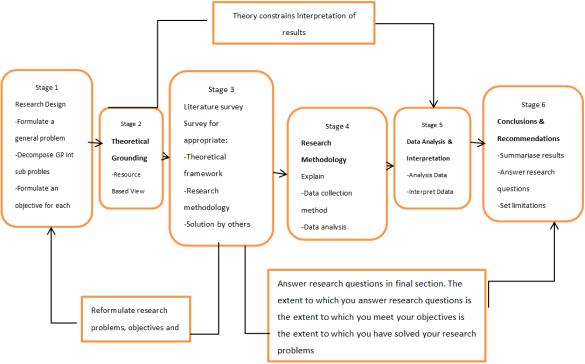
In summary, the research study started with the research design, the planning phase of research, when a research problem was devised and decomposed into specific sub-problems, followed by preparing objectives for each of the sub-problems
| [29] | Klopper, H. B. (2010). The problem-solving approach in qualitative research. Oxford University Press. |
| [52] | Tracy, S. J. (2020). Qualitative research methods: Collecting evidence, crafting analysis, communicating impact (3rd ed.). Wiley-Blackwell. |
[29, 52]
. Thus, to answer the above questions, a mixed research method, that is, questionnaires and semi-structured interviews with the firms‘ responsible managers, was developed. The study was designed as a problem-solution-oriented approach. As adopted from
| [30] | Klopper, R. and Lubbe, S., 2012. Using matrix analysis to achieve traction, coherence, progression and closure in problem-solution oriented research, CONF-IRM 2012 Proceedings. 18, http://aisel.aisnet.org/confirm2012/1 |
[30]
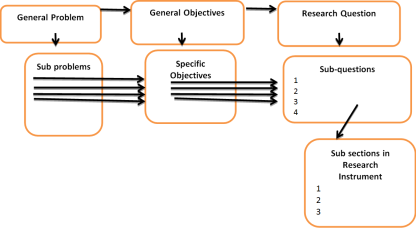
in problem-solution oriented research, the research questions, research problems and objectives needed to align as stated in the figure on the previous page.
As shown from the figure, the problem solution approach begins with the general problem, which is generated from a general aim and decomposed into sub-problems. Also, the general problem is split into a number of sub-problems from which specific objectives were generated, and in turn, a number of specific research questions were derived. The research sub-questions form the basis of sections in the research instrument, where each sub-question is taken out in a series of more detailed survey questions. There would be as many subsections in the survey instrument as there are research sub-questions
| [52] | Tracy, S. J. (2020). Qualitative research methods: Collecting evidence, crafting analysis, communicating impact (3rd ed.). Wiley-Blackwell. |
[52]
. Moreover, the general research questions derived from general objectives were decomposed into sub-problems via the research questions as a source for the research instrument. The research instruments were questionnaires in the case of quantitative research and an interview in the case of qualitative research to help answer the research questions through the interpretation of empirical data to meet the research objectives and in general to solve the research problems
| [52] | Tracy, S. J. (2020). Qualitative research methods: Collecting evidence, crafting analysis, communicating impact (3rd ed.). Wiley-Blackwell. |
[52]
.
Data Source and Collection Methods
The data was collected from the firms’ knowledgeable, higher managerial positions, directors or owners of manufacturing firms in Ethiopia. However, the selection of appropriate respondents to be contacted within the firm was an important issue
| [18] | Gloria, A. M. (2016). Advanced research methodology in business and economics. Routledge. |
| [26] | Henseler, J., Ringle, C. M., & Sarstedt, M. (2015). A new criterion for assessing discriminant validity in variance-based structural equation modeling. Journal of the Academy of Marketing Science, 43(1), 1–16. https://doi.org/10.1007/s11747-014-0430-6 |
| [31] | Lages, L. F., Lages, C. R., & Lages, J. E. (2008a). The RELPER scale of export performance. Journal of International Marketing, 16(2), 25–57.
https://doi.org/10.1509/jimk.16.2.25 |
| [55] | Worku, B. G. (2016). Determinants of export performance of manufacturing firms in Ethiopia. Ethiopian Journal of Economics, 25(1), 1–28. |
[18, 26, 31, 55]
. This was carried out by distributing the questionnaires and seeking responses from the key staff within the firm [18; 45].
The study used secondary and primary sources of data. Primary data were collected specifically for this research via direct contact with export managers
| [18] | Gloria, A. M. (2016). Advanced research methodology in business and economics. Routledge. |
| [31] | Lages, L. F., Lages, C. R., & Lages, J. E. (2008a). The RELPER scale of export performance. Journal of International Marketing, 16(2), 25–57.
https://doi.org/10.1509/jimk.16.2.25 |
| [55] | Worku, B. G. (2016). Determinants of export performance of manufacturing firms in Ethiopia. Ethiopian Journal of Economics, 25(1), 1–28. |
[18, 31, 55]
. The primary data were collected through self-designed questionnaires and semi-structured interviews with export firm managers. On the other hand, the secondary data were collected from existing literature, different research journals and papers, relevant books, and the internet.
The qualitative method was used to analyse the data collected through interviews (Gloria, 2016). However, the quantitative technique was used to analyse the data collected through questionnaires
| [18] | Gloria, A. M. (2016). Advanced research methodology in business and economics. Routledge. |
[18]
. Two university graduates, who were familiar with business research methods, were recruited as data enumerators. They have had previous data collection experience. Before the field survey, they were trained regarding the purpose of the research, sampling method, and contents of the questionnaire and on how to approach the respondents. They collected the data under the supervision of the researchers.
Thus, the present study investigated a face-to-face survey with owners or senior managers, who were in charge of exporting activities for their respective firms. This method was also suitable when the respondents needed some clarifications in relation to the content of the questionnaire
| [18] | Gloria, A. M. (2016). Advanced research methodology in business and economics. Routledge. |
| [26] | Henseler, J., Ringle, C. M., & Sarstedt, M. (2015). A new criterion for assessing discriminant validity in variance-based structural equation modeling. Journal of the Academy of Marketing Science, 43(1), 1–16. https://doi.org/10.1007/s11747-014-0430-6 |
| [55] | Worku, B. G. (2016). Determinants of export performance of manufacturing firms in Ethiopia. Ethiopian Journal of Economics, 25(1), 1–28. |
| [59] | Zikmund, W. G., Babin, B. J., Carr, J. C., & Griffin, M. (2013). Business research methods (9th ed.). South-Western Cengage Learning. |
[18, 26, 55, 59]
.
5.5. Key Informant
Identifying the right informant was an essential framework to collect high-quality data and also a requirement for discovering precise research findings
| [18] | Gloria, A. M. (2016). Advanced research methodology in business and economics. Routledge. |
| [56] | World Bank Group. (2023). Africa's pulse: An analysis of economic development in Sub-Saharan Africa. |
[18, 56]
. This was performed by delivering the questionnaires and asking for responses from the key informants within the firm
| [18] | Gloria, A. M. (2016). Advanced research methodology in business and economics. Routledge. |
[18]
. Key informants were not chosen as they are representatives, but because of the exceptional knowledge with a special position they had in a firm at the time of the survey
| [26] | Henseler, J., Ringle, C. M., & Sarstedt, M. (2015). A new criterion for assessing discriminant validity in variance-based structural equation modeling. Journal of the Academy of Marketing Science, 43(1), 1–16. https://doi.org/10.1007/s11747-014-0430-6 |
| [56] | World Bank Group. (2023). Africa's pulse: An analysis of economic development in Sub-Saharan Africa. |
[26, 56]
.
Thus, in relation to export performance, key informants would be likely to have the highest knowledge with firm’s information and key informants targeted for this study were either owners or managers of the firm or any other responsible person within the firm who was actively involved in the export-making decision process. As a result, it was decisive to collect data from a single knowledgeable respondent. They were also integral to the firm’s policymaking regarding international business operations to explain the occurrence of questioning
| [18] | Gloria, A. M. (2016). Advanced research methodology in business and economics. Routledge. |
| [32] | Lages, L. F., Lages, C. R., & Lages, J. E. (2008b). Key informant technique in export marketing research: A systematic review and future research directions. International Marketing Review, 25(6), 661–689.
https://doi.org/10.1108/02651330810920038 |
[18, 32]
. Consequently, the single key-informant technique seemed to be well-favoured and as a result the present study centred on a single knowledgeable respondent from every export firm
| [18] | Gloria, A. M. (2016). Advanced research methodology in business and economics. Routledge. |
| [34] | Leonidou, L. C., & Katsikeas, C. S. (2013). The determinants of export performance: A review of the empirical literature. Routledge. |
| [50] | Sousa, C. M. B., & Novello, J. D. (2014). The effect of environmental diversity on export price adaptation. Journal of International Marketing, 22(4), 1–19.
https://doi.org/10.1509/jim.13.0062 |
| [51] | Sousa, C. M. B., Martínez-López, F. J., & Coelho, A. F. (2008). The determinants of export performance: A review of the research and a conceptual model. International Business Review, 17(2), 133–157.
https://doi.org/10.1016/j.ibusrev.2007.12.001 |
| [58] | Yousra, M. (2011). Key informant technique in marketing research. Journal of Marketing Research and Case Studies, 2(1), 1–12. |
[18, 34, 50, 51, 58]
.
5.6. Questionnaire Design
The questionnaire was designed to collect information on managers’ points of view in relation to the export performance
| [18] | Gloria, A. M. (2016). Advanced research methodology in business and economics. Routledge. |
| [35] | Lietz, P. (2010). Research into questionnaire design: A review of the literature. International Journal of Educational and Psychological Assessment, 3(1), 1–25.
https://doi.org/10.2501/S147078530920120X |
[18, 35]
. Hence, in the present study, the questionnaires were categorised into ten (10) parts as: (1) respondents’ demography; (2) firms’ profile: (3) Firm’s competitive intensity; (4) technological intensity (5) foreign market characteristics; (6) firm characteristics; (7) managerial determinants; (8) Export Marketing mix Strategy, (9) Export performance and (10) general questions.
The researchers decided on the measurement scales recognised as being valid and reliable from the literature
| [18] | Gloria, A. M. (2016). Advanced research methodology in business and economics. Routledge. |
| [35] | Lietz, P. (2010). Research into questionnaire design: A review of the literature. International Journal of Educational and Psychological Assessment, 3(1), 1–25.
https://doi.org/10.2501/S147078530920120X |
| [56] | World Bank Group. (2023). Africa's pulse: An analysis of economic development in Sub-Saharan Africa. |
[18, 35, 56]
. A Likert scale was used to measure the theoretical constructs on multiple items (a five-point Likert scale) that required respondents to point out a degree of satisfaction, agreement, applicability, importance, rate of success, etc., within a range of statements allied with the research
| [18] | Gloria, A. M. (2016). Advanced research methodology in business and economics. Routledge. |
| [35] | Lietz, P. (2010). Research into questionnaire design: A review of the literature. International Journal of Educational and Psychological Assessment, 3(1), 1–25.
https://doi.org/10.2501/S147078530920120X |
[18, 35]
. All measures were performed with fixes 1 = very dissatisfied and 5 = very satisfied, or 1 = strongly disagree and 5 = strongly agree. The study also depended on previously validated scales published in journals. The entire measures provided a strong indication of reliability and validity and an acceptable Cronbach’s Alpha
| [17] | Glavas, C., & Mathews, S. (2014). Export marketing strategy, resources, and performance: A structural equation modeling approach. International Marketing Review, 31(5), 458–483.
https://doi.org/10.1108/IMR-07-2013-0149 |
| [28] | Kline, R. B. (2024). Principles and practice of structural equation modeling (5th ed.). The Guilford Press. |
[17, 28]
. The nature of the survey questionnaire employed in this study was depicted as an abundantly structured design with closed-ended questions.
5.7. Instrument Validation Process
Pre-testing was the groundwork for a questionnaire in a small pilot study to find out the quality of the survey instrument before using it in a mass survey
| [26] | Henseler, J., Ringle, C. M., & Sarstedt, M. (2015). A new criterion for assessing discriminant validity in variance-based structural equation modeling. Journal of the Academy of Marketing Science, 43(1), 1–16. https://doi.org/10.1007/s11747-014-0430-6 |
[26]
. A pre-test of ten to twenty representative respondents was usually sufficient to identify problems with a questionnaire
| [26] | Henseler, J., Ringle, C. M., & Sarstedt, M. (2015). A new criterion for assessing discriminant validity in variance-based structural equation modeling. Journal of the Academy of Marketing Science, 43(1), 1–16. https://doi.org/10.1007/s11747-014-0430-6 |
[26]
. As a result, 20 firms’ executives were randomly selected from the list of exporters with similar characteristics as the target population but who would not be taking part in the final survey. They were approached to review the questionnaire in order to identify which questions were difficult to answer, which ones were ambiguous, which terms were misinterpreted, and which sections were too long. After obtaining their feedback, the final version of the questionnaire was presented.
Several researchers recommended that the pre-test ought to be carried out through personal interviews since they enabled the researchers to become aware of the respondents’ responses and uncertainties, which might not be found via other techniques
| [26] | Henseler, J., Ringle, C. M., & Sarstedt, M. (2015). A new criterion for assessing discriminant validity in variance-based structural equation modeling. Journal of the Academy of Marketing Science, 43(1), 1–16. https://doi.org/10.1007/s11747-014-0430-6 |
| [59] | Zikmund, W. G., Babin, B. J., Carr, J. C., & Griffin, M. (2013). Business research methods (9th ed.). South-Western Cengage Learning. |
[26, 59]
. Besides, the instrument was also discussed with content experts and practitioners in the field of international marketing research to evaluate and comment on the instrument, including scale items, question content, wording, form layout, question difficulty, instructions, sequencing and timing
| [18] | Gloria, A. M. (2016). Advanced research methodology in business and economics. Routledge. |
| [35] | Lietz, P. (2010). Research into questionnaire design: A review of the literature. International Journal of Educational and Psychological Assessment, 3(1), 1–25.
https://doi.org/10.2501/S147078530920120X |
[18, 35]
. The preliminary questionnaire was reviewed by two academicians and four doctoral students who were knowledgeable in the field of study to evaluate the questionnaire items for face validity of the constructs.
5.8. Interview Questions
The interviews were carried out via face-to-face at the experts’ office and audio recorded, as it would be conducive for discussion of the role of the export market
| [57] | Yin, R. K. (2018). Case study research and applications: Design and methods (6th ed.). Sage Publications. |
[57]
. The qualitative interviews were investigated and supplemented insights into determinants of export performance to complement the quantitative study for triangulation of findings and might advance theory in international markets
| [17] | Glavas, C., & Mathews, S. (2014). Export marketing strategy, resources, and performance: A structural equation modeling approach. International Marketing Review, 31(5), 458–483.
https://doi.org/10.1108/IMR-07-2013-0149 |
[17]
. Thus, the researchers employed semi-structured interviews to collect primary qualitative data to smooth the progress of the researchers’ comprehensive investigation and increase the validity of information
| [18] | Gloria, A. M. (2016). Advanced research methodology in business and economics. Routledge. |
| [57] | Yin, R. K. (2018). Case study research and applications: Design and methods (6th ed.). Sage Publications. |
[18, 57]
. Moreover, the centre of the interview was to discover and gain exploratory knowledge on export practices in Ethiopia. Ten interviews were deemed adequate as several ideas were designed from the primary data to give broader insights into exporting practices of firms, which was consistent with other studies in the field, but data saturation was kept in mind
| [8] | Chang, T. Z., Li, Y. H., & Yen, H. R. (2010). A study of the factors affecting export performance of Taiwanese SMEs. International Business Research, 3(2), 10–23.
https://doi.org/10.1108/JBIM-03-2016-0043 |
| [31] | Lages, L. F., Lages, C. R., & Lages, J. E. (2008a). The RELPER scale of export performance. Journal of International Marketing, 16(2), 25–57.
https://doi.org/10.1509/jimk.16.2.25 |
| [51] | Sousa, C. M. B., Martínez-López, F. J., & Coelho, A. F. (2008). The determinants of export performance: A review of the research and a conceptual model. International Business Review, 17(2), 133–157.
https://doi.org/10.1016/j.ibusrev.2007.12.001 |
[8, 31, 51]
. Each interview lasted approximately 60 minutes.
5.9. Validity and Reliability of the Research Study
The multi-item scales used in the study were evaluated to ensure that they can realise sufficient levels of reliability and validity
| [26] | Henseler, J., Ringle, C. M., & Sarstedt, M. (2015). A new criterion for assessing discriminant validity in variance-based structural equation modeling. Journal of the Academy of Marketing Science, 43(1), 1–16. https://doi.org/10.1007/s11747-014-0430-6 |
[26]
. The researchers have designed questionnaires based on the literature review and their knowledge of the study area.
Reliability
Reliability refers to the consistency of the results obtained from a research study
| [26] | Henseler, J., Ringle, C. M., & Sarstedt, M. (2015). A new criterion for assessing discriminant validity in variance-based structural equation modeling. Journal of the Academy of Marketing Science, 43(1), 1–16. https://doi.org/10.1007/s11747-014-0430-6 |
[26]
.. This research study contained a significant amount of triangulation, which demanded both quantitative and qualitative approaches to collect data. It measured the consistency of a questionnaire and the Cronbach’s alpha values
| [14] | Field, A. (2023). Discovering statistics using IBM SPSS Statistics (6th ed.). Sage Publications. |
| [26] | Henseler, J., Ringle, C. M., & Sarstedt, M. (2015). A new criterion for assessing discriminant validity in variance-based structural equation modeling. Journal of the Academy of Marketing Science, 43(1), 1–16. https://doi.org/10.1007/s11747-014-0430-6 |
[14, 26]
.
Reliability addresses whether repeated assessments consistently come up with the same results when performed under the same circumstances
| [26] | Henseler, J., Ringle, C. M., & Sarstedt, M. (2015). A new criterion for assessing discriminant validity in variance-based structural equation modeling. Journal of the Academy of Marketing Science, 43(1), 1–16. https://doi.org/10.1007/s11747-014-0430-6 |
[26]
. The data from the questionnaires were easily quantifiable, as the data would not be open to subjective interpretation
| [26] | Henseler, J., Ringle, C. M., & Sarstedt, M. (2015). A new criterion for assessing discriminant validity in variance-based structural equation modeling. Journal of the Academy of Marketing Science, 43(1), 1–16. https://doi.org/10.1007/s11747-014-0430-6 |
[26]
. The researchers believed that independent researchers, on reanalysing the data, would come to the same conclusions. If an independent researcher utilised this data collection method, the researcher would be likely to reach the same conclusion
| [26] | Henseler, J., Ringle, C. M., & Sarstedt, M. (2015). A new criterion for assessing discriminant validity in variance-based structural equation modeling. Journal of the Academy of Marketing Science, 43(1), 1–16. https://doi.org/10.1007/s11747-014-0430-6 |
[26]
.
5.10. Validity
Validity analysis is an essential part of an empirical study
| [4] | Brown, T. A. (2023). Confirmatory factor analysis for applied research (3rd ed.). The Guilford Press. |
| [14] | Field, A. (2023). Discovering statistics using IBM SPSS Statistics (6th ed.). Sage Publications. |
| [26] | Henseler, J., Ringle, C. M., & Sarstedt, M. (2015). A new criterion for assessing discriminant validity in variance-based structural equation modeling. Journal of the Academy of Marketing Science, 43(1), 1–16. https://doi.org/10.1007/s11747-014-0430-6 |
| [44] | Radomir, L., & Moisescu, O. I. (2020). Discriminant validity assessment: A comparison of three approaches. Marketing Journal, 8(1), 11–28. |
[4, 14, 26, 44]
. Validity refers to the extent to which a research study investigates what the researchers claim to investigate
| [28] | Kline, R. B. (2024). Principles and practice of structural equation modeling (5th ed.). The Guilford Press. |
[28]
. Internal validity concerns whether the understanding of the study design supported clear conclusions from the results of the research
. To assure the internal validity of the research, triangulation of data collection sources was used
| [22] | Hair, J. F., Ringle, C. M., & Sarstedt, M. (2014a). PLS-SEM: Indeed a silver bullet. Journal of Marketing Theory and Practice, 22(2), 139–151. https://doi.org/10.2753/MTP1069-6679220202 |
| [26] | Henseler, J., Ringle, C. M., & Sarstedt, M. (2015). A new criterion for assessing discriminant validity in variance-based structural equation modeling. Journal of the Academy of Marketing Science, 43(1), 1–16. https://doi.org/10.1007/s11747-014-0430-6 |
[22, 26]
. Construct validity was accessed through Confirmatory Factor Analysis (CFA) and Exploratory Factor Analysis (EFA)
| [26] | Henseler, J., Ringle, C. M., & Sarstedt, M. (2015). A new criterion for assessing discriminant validity in variance-based structural equation modeling. Journal of the Academy of Marketing Science, 43(1), 1–16. https://doi.org/10.1007/s11747-014-0430-6 |
| [28] | Kline, R. B. (2024). Principles and practice of structural equation modeling (5th ed.). The Guilford Press. |
[26, 28]
. Exploratory Factor Analysis provided different factor solutions, which would let the data suggest possible factors.
Where the research was new and emerging, the researchers needed to use EFA at the first stage to explore these factors and to search in the literature for a validated questionnaire
| [4] | Brown, T. A. (2023). Confirmatory factor analysis for applied research (3rd ed.). The Guilford Press. |
[4]
. This could then be tested by Confirmatory Factor Analysis
| [3] | Brouthers, L. E., Nakos, G., Hadjimarcou, J., & Brouthers, K. D. (2013). Key factors for successful export performance for small firms. Journal of International Marketing, 21(3), 85–104. https://doi.org/10.1509/jim.13.0035 |
| [4] | Brown, T. A. (2023). Confirmatory factor analysis for applied research (3rd ed.). The Guilford Press. |
| [10] | Creswell, J. W., & Creswell, J. D. (2023). Research design: Qualitative, quantitative, and mixed methods approaches (6th ed.). Sage Publications. |
[3, 4, 10]
. In this research, the collected data were tested by exploratory factor analysis (EFA) to prove the structural validity of the scale (the capability of items of measuring the variables)
| [4] | Brown, T. A. (2023). Confirmatory factor analysis for applied research (3rd ed.). The Guilford Press. |
[4]
. For this reason, exploratory factor analysis (EFA) was suitable to examine the factor structure within each construct group
| [4] | Brown, T. A. (2023). Confirmatory factor analysis for applied research (3rd ed.). The Guilford Press. |
| [14] | Field, A. (2023). Discovering statistics using IBM SPSS Statistics (6th ed.). Sage Publications. |
| [26] | Henseler, J., Ringle, C. M., & Sarstedt, M. (2015). A new criterion for assessing discriminant validity in variance-based structural equation modeling. Journal of the Academy of Marketing Science, 43(1), 1–16. https://doi.org/10.1007/s11747-014-0430-6 |
| [44] | Radomir, L., & Moisescu, O. I. (2020). Discriminant validity assessment: A comparison of three approaches. Marketing Journal, 8(1), 11–28. |
[4, 14, 26, 44]
.
Therefore, for a scale development study, first an EFA was used in order to discover the underlying latent structure and then CFA using the same data set
| [20] | Güvendir, H., & Özkan, B. (2015). Comparison of factor analysis methods: A simulation study. Journal of Applied Quantitative Methods, 10(1), 38–47.
https://doi.org/10.1002/j.1556-6676.1994.tb02117.x |
| [46] | Schumacker, R. E., & Lomax, R. G. (2024). A beginner's guide to structural equation modeling (5th ed.). Routledge. |
[20, 46]
. In order for a study to be generalisable in a wider context, it should be possible to assume that the sample used in the research is representative of the general population to which the research results were tied
| [5] | Byrne, B. M. (2016). Structural equation modeling with Mplus: Basic concepts, applications, and programming. Routledge. |
| [21] | Hair, J. F., Hult, G. T. M., Ringle, C. M., & Sarstedt, M. (2022). A primer on partial least squares structural equation modeling (PLS-SEM) (3rd ed.). Sage Publications. |
| [22] | Hair, J. F., Ringle, C. M., & Sarstedt, M. (2014a). PLS-SEM: Indeed a silver bullet. Journal of Marketing Theory and Practice, 22(2), 139–151. https://doi.org/10.2753/MTP1069-6679220202 |
| [26] | Henseler, J., Ringle, C. M., & Sarstedt, M. (2015). A new criterion for assessing discriminant validity in variance-based structural equation modeling. Journal of the Academy of Marketing Science, 43(1), 1–16. https://doi.org/10.1007/s11747-014-0430-6 |
[5, 21, 22, 26]
. Consequently, the researchers believed that the sample population was defined and that the findings could be applied to other populations of export firms and their instruments and measures could be reliable and valid
| [3] | Brouthers, L. E., Nakos, G., Hadjimarcou, J., & Brouthers, K. D. (2013). Key factors for successful export performance for small firms. Journal of International Marketing, 21(3), 85–104. https://doi.org/10.1509/jim.13.0035 |
| [4] | Brown, T. A. (2023). Confirmatory factor analysis for applied research (3rd ed.). The Guilford Press. |
[3, 4]
.
Furthermore, the researchers attempted to influence respondents to change their responses on the questionnaires or during interviews. The design and content validity of this questionnaire were scrutinised by the supervisor, two academicians and four doctoral students believed knowledgeable and have had ample experience in international business research. And then the required modifications were practised on the questionnaire.
6. Model Specification
The regression model, Probit model, and Tobit model have been employed to investigate factors that determine export performance. The dependent variable, export performance, was represented by five constructs: annual export intensity, export profit, export growth, goal achievement, and satisfaction. On the other hand, the independent or explanatory variables were managerial factors, firm characteristics, export marketing mix strategy, competitive intensity, foreign market characteristics, and technological factors.
6.1. The Tobit Model for Export Intensity
A multinomial Tobit model has been adopted in order to model factors that determine the export intensity variable
| [36] | Lin, T. B., & Lee, K. C. (2020). The application of Tobit model in finance research. Journal of Applied Finance & Banking, 10(3), 1–15. |
| [54] | Wooldridge, J. M. (2020). Introductory econometrics: A modern approach (7th ed.). Cengage Learning. |
[36, 54]
. The Tobit model was used to find out the factors that influence the intensity of export performance
| [36] | Lin, T. B., & Lee, K. C. (2020). The application of Tobit model in finance research. Journal of Applied Finance & Banking, 10(3), 1–15. |
| [54] | Wooldridge, J. M. (2020). Introductory econometrics: A modern approach (7th ed.). Cengage Learning. |
[36, 54]
. At this time, the binary dependent variable—successful or not successful—was not suitable
| [36] | Lin, T. B., & Lee, K. C. (2020). The application of Tobit model in finance research. Journal of Applied Finance & Banking, 10(3), 1–15. |
| [54] | Wooldridge, J. M. (2020). Introductory econometrics: A modern approach (7th ed.). Cengage Learning. |
[36, 54]
. Furthermore,
| [54] | Wooldridge, J. M. (2020). Introductory econometrics: A modern approach (7th ed.). Cengage Learning. |
[54]
, in his study, acknowledged that important information is lost because of the use of a binary dependent variable. The dependent variable employed at this point was then censored at achievement
| [54] | Wooldridge, J. M. (2020). Introductory econometrics: A modern approach (7th ed.). Cengage Learning. |
[54]
. Since not all firms necessarily earn aggregated export sales revenue, there is a possibility that the dependent variable may have zero values
| [36] | Lin, T. B., & Lee, K. C. (2020). The application of Tobit model in finance research. Journal of Applied Finance & Banking, 10(3), 1–15. |
| [54] | Wooldridge, J. M. (2020). Introductory econometrics: A modern approach (7th ed.). Cengage Learning. |
[36, 54]
.
With so many zero values for the dependent variable, using Ordinary Least Squares (OLS) to estimate the model would lead to biased and inconsistent results
| [36] | Lin, T. B., & Lee, K. C. (2020). The application of Tobit model in finance research. Journal of Applied Finance & Banking, 10(3), 1–15. |
| [54] | Wooldridge, J. M. (2020). Introductory econometrics: A modern approach (7th ed.). Cengage Learning. |
[36, 54]
. The Censored Tobit model was an appropriate tool to obtain unbiased and consistent estimations
| [36] | Lin, T. B., & Lee, K. C. (2020). The application of Tobit model in finance research. Journal of Applied Finance & Banking, 10(3), 1–15. |
| [54] | Wooldridge, J. M. (2020). Introductory econometrics: A modern approach (7th ed.). Cengage Learning. |
[36, 54]
.
Thus, to find out intensity-dependent variables for analysis, the mean index (the mean performance score) was subtracted from the average score of every firm’s collective (aggregate) performance score
| [54] | Wooldridge, J. M. (2020). Introductory econometrics: A modern approach (7th ed.). Cengage Learning. |
[54]
. Hence, scores with negative outcome values were labelled as zero (0) and those with positive outcomes were traced in their absolute terms
| [36] | Lin, T. B., & Lee, K. C. (2020). The application of Tobit model in finance research. Journal of Applied Finance & Banking, 10(3), 1–15. |
| [56] | World Bank Group. (2023). Africa's pulse: An analysis of economic development in Sub-Saharan Africa. |
[36, 56]
. Therefore, the intensity of export performance represented the degree to which a firm’s average score deviates from the mean
| [36] | Lin, T. B., & Lee, K. C. (2020). The application of Tobit model in finance research. Journal of Applied Finance & Banking, 10(3), 1–15. |
| [54] | Wooldridge, J. M. (2020). Introductory econometrics: A modern approach (7th ed.). Cengage Learning. |
[36, 54]
.
6.2. The Probit Model for Goal Achievement and Satisfaction
A multinomial Probit model was used to identify the effect of independent variables on goal achievement and satisfaction. The Probit model was preferred for dichotomous (0−1) dependent variables rather than continuous ones
| [54] | Wooldridge, J. M. (2020). Introductory econometrics: A modern approach (7th ed.). Cengage Learning. |
[54]
. Regression models that include yes/no or present/absent type of response are known as dichotomous or dummy dependent variables, and the determinants of an event happening or not happening were identified.
Thus, in the estimation of determinants of goal achievement or satisfaction on export, the probit model was going to be employed since Probit was a powerful tool in its ability to estimate the individual effects of the categorical variables on a qualitative dichotomous dependent variable, whether the success/satisfaction was perceived or not. In this regard, this model lent itself to meaningful interpretations when the dependent variable was a dichotomous outcome.
Regression through ordinary least squares (OLS) is a commonly applied statistical technique. Though when the dependent variable is dichotomous (0−1) rather than continuous, OLS becomes an inefficient prediction method and the underlying linear probability model (LPM) that was being estimated signifies a poor choice of model specification.
Hence, when noncontiguous dependent variables were used, for instance, in a 5-point Likert scale ranging from very satisfied to very dissatisfied, satisfied and very satisfied responses are almost similar. So, in this case, instead of creating confusion, it would be better to change the binary result variable to either satisfied or dissatisfied. That was why the Probit model was preferred for dichotomous (0−1) rather than continuous. So, the satisfaction marks for each element were clustered in either unsatisfied (0) or satisfied (1) to form a binary result variable.
The Manager’s satisfaction level composite index formula (MSI) was computed as follows:
Where:
M = stands for Managers for a given export firm
MSI = is the overall satisfaction index for each respondent that ranges from 0 to 1,
Wi = is the level of satisfaction in each attribute for each respondent (with a series of choices ranging from “very satisfied” to “very dissatisfied”),
ST = is the maximum relative satisfaction level of the respondent.
Manager’s Satisfaction Index (MSI) is the yardstick or standard to measure the level of satisfaction in numerous attributes of export performance. Moreover, the index of managers’ satisfaction would also be a complementary dependent variable, which was useful to identify factors affecting managers’ satisfaction level with vigorous export performance. In order to measure the level of respondents’ satisfaction, the researchers identified the most important predictors.
The qualitative nature of the indicators was measured by scoring that could be organised to develop a satisfaction index by simply adding the scoring from the Likert model and dividing it by the total possible maximum score in order to measure the overall managers’ satisfaction index. Based on the overall satisfaction index, the dependent variable was formed by changing the values into one (those values greater than or equal to the mean value of the dependent variable) and zero (those values less than the mean value of the dependent variable).
The same procedures were applied for measuring managers’ goal achievement measurements, and a binary outcome variable was formed in the same manner. Finally, the regression model (OLS) was an appropriate technique for identifying export profit and export growth variables since the dependent variable takes a continuous measure where growth/profit data are commonly treated as continuous variables
.
General Research Model
Thus, the general research model for this study (adapted from 12) is:
Where:
Yi = indicates the dependent variables, it was export performance and represented by five constructs (export intensity, export growth, export profitability, goal achievement and satisfaction).
Xi = was a vector of factors affecting export performance: manager’s foreign language skills, firm size, manager’s international experience, firm export experience, product adaptation strategies, pricing competitiveness, distribution strategies, promotion intensity, competitive intensity, government rules and regulations, cultural dissimilarity, and technological factors.
βi = a vector of parameters to be estimated/ was a vector of Tobit maximum likelihood estimates.
ϵ = is the error term, which was assumed to have a normal distribution.
To investigate the determinants of a firm’s export performance, the study considered export performance as defined as the amount earned from export across different products
| [12] | Drama, N., Nuroğlu, E., & Keke, B. (2014). A conceptual model of export performance in Turkish SMEs. International Journal of Business and Social Science, 5(9), 11–22.
https://doi.org/10.1007/978-3-319-49774-6\_24 |
| [36] | Lin, T. B., & Lee, K. C. (2020). The application of Tobit model in finance research. Journal of Applied Finance & Banking, 10(3), 1–15. |
[12, 36]
. This study used the simple regression model to determine the factors that affect export performance (EP). For the simplicity and accuracy of the results of the study, twelve factors were identified as variables that influence the export performance of firms.
Therefore, the export Performance equation was expressed as follows:
EP=f(CI,TF,FMC,FS,FIE,MLS,MIE,PDA,PRA,PMA,PLA,ϵ)(2)
Where:
EP = Export Performance
CI = Competitive Intensity
TF = Technological Factors
FMC = Foreign Market Characteristics
FS = Firm Size
FIE = Firm International Experience
MLS = Manager’s Language Skill
MIE = Manager’s International Experience
PDA = Product Adaption;
PRA = Price Adaption;
PMA = Promotion Adaption;
PLA = Place (distribution) Adaptation)
ϵ = Dummy variable to capture other factors that influence export performance
Thus, the export performance model could be specified in a linear relationship through a regression equation as follows:
Yi=β0+β1CI+β2TF+β3FMC+β4FS+β5FIE+β6MLS+β7MIE+β8PDA+β9PRA+β10PMA+β11PLA+ϵ(3)
Where: β1 to β11>0 (implying the expected positive relationship between the independent factors and export performance).
The present study adopted the same approaches that were employed by previous researchers who investigated the determinants of a firm’s export performance
. Though some adaptations were made to make known the firm's situation.





 Share This Article
 Twitter
 Linked In
 Facebook
 Copy
Copy Download